Showing posts with label Moscow - Touring. Show all posts

Tuesday, June 3, 2014

VDNKh Park

The former Exhibition of Economic Achievements of the USSR (VDNKh) is now the All-Russian Exhibition Centre.  The park has had various purposes throughout history.  Begun in 1939 is was used as a major agricultural exhibition.  Twenty years later it was chanted to a vast park to show off the nation's achievements in economics, science and technology.  After the Soviet Union collapsed in 1991, the grounds and pavilions became private businesses.  Many of the exhibit halls are still used as retail showrooms, yet the complex is only a shadow of what it used to be.
Damon and I took the metro on Memorial Day to search out some memorabilia left over from the Soviet days.  We spent a few hours slowly wandering the park and gazing at the monuments.  They are all quiet impressive and speak of an ideal that never quiet worked out.  
A portion of the park is an amusement park complete with a midway, small roller coasters and a large, rather rickety looking ferris wheel.


Space Obelisk
built (1964) 3 years after Yuriy Gagarin became the first man in space 


Main entrance
tractor driver and woman collective farmer


the Russian way to water the lawn.  This truck drove around and around and around to water the grass!


Massive monument to Lenin


Beautiful fountain made of gold mosaic.
People are encouraged to swim!


This is what we came to see!  It was a bit of a hike once we spotted it but well worth the extra walking.  The statue Worker and Woman Collective Farm Worker is made of stainless steel.  Vera Mukhina created this for the Paris Exhibition in 1937 to symbolize the glory and power of the Soviet Union.  With the hammer and sickle raised far above the man and woman's heads, they scream Soviet to the viewing world.  This symbol was chosen to be used on posters for "Mosfilm", one of the most well known Russian movie studios, making it famous throughout the world.  This statue represents a main Soviet ideal where the government owned all the land and the people did all the work.  As soon as Damon saw the statue in the distance he exclaimed "I've seen that symbol before!  It's very famous."
A few nights later we happened to be out driving at night - stuck in slowly moving traffic.  I had a chance to look around and noticed that we were on the highway that goes right past this park.  Each monument was lit-up and looked stunning.     

Monday, March 31, 2014

Church of the Assumption of the Blessed Virgin in Potters Quarter


There are more than 600 Orthodox churches here in Moscow - more than I could ever hope to visit during our time here, but every opportunity I have I like to take the time to walk inside and look around.  It's important for women to wear a head covering while inside so I try to keep a scarf with me, or for the times I've been without, my knit winter hat has worked or a hood as well.  Men do not cover their heads, so it's just as important to remove their hat before entering.

I was out with a friend on this particular day so we knew we would be stopping by to see it.  This church is located off the Taganskaya Metro only a block to the north-west.  

This is definitely one of my favorites so far, it is small, intimate and ornate.  It's easy to think that "it's just another church" in this city overflowing with churches, but each one is unique with its own story to tell.  

Like many churches, a wooden church was originally built here along with a monastery in the late 16th century.  Because pottery and blacksmithing were essential trades that used fire, buildings frequently burned down.  

In the 17th century Moscow had over 900 churches so travelers referred to it as a magic city glimmering with thousands of golden domes.  The city remained this way until the early 20th century just before the revolution.  

In the 17th century the potters were concentrated into one section of the city to confine their fire kilns and protect the city.  This area became known as "the potter's quarter".  

In 1654, after the original wooden structure burned, a new church was built of stone.  The potters in the area joined together to provide financing as well as skilled labor to build a church.  Unique details from their craft are seen in ornate tiles decorating the exterior of the building.  Red paint with white trim was typical of the period as brighter colors were beginning to be used in architecture.  The five domes seem miniature thinking of other domes in the skyline, but they are in proportion to the miniature size of the church.

The interior is stunning.  It is covered with frescos and gliding as is typical but the intimacy of the room brings the art close.  The scent of melted bees wax floated throughout the room as I wandered around peering at the many original icons.  

This is one of the few churches that was not closed, destroyed or re-purposed during the Soviet era.  Believers in the church attribute this to the icon of the The Mother of God with "Three Hands".  Yep, you read that correctly.  This icon indeed has Mary with two hands holding the baby Jesus and a third hand awkwardly coming out of her robe, reaching for the baby in a bit of a creepy fashion.  The history of this third hand actually simply comes from a painter's misinterpretation of an earlier icon.  Legend says that John of Damascus was praying before the icon of Mary when his hand was cut off.  Mary in the icon miraculously reattached John's hand and a silver hand was attached to the painting in commemoration of the miracle.  When this painting was copied by other painters, the third hand was simply painted in. 


Monday, December 16, 2013

Ice Skating in Gorky Park

A few weeks ago we went to buy ice skates since we had been hearing about the great places to ice skate. Snow was late this year, so last Friday we decided there was finally enough snow to go. Elena brought along a friend, and we took a bus several stops over to Gorky Park.

The first thing we saw was a huge Christmas tree made of draping white lights in the middle of a square. Just when we were about to take a picture in front of it, two Russisan guys came over and hopped in our picture! It was very funny, but we were disappointed because the picture didn't come out well.

Past the Christmas tree were arches of lights that formed tunnels. It was so pretty to walk through the colorful tunnels of light. Once again we wanted a picture. We stood in a tunnel and got ready for our picture, and to our surprise, more Russians hopped in our picture, this time holding a baby over our heads!
The Russians must have been happy that night.


We payed the entrance fee and put our skates on. I walked over to the ice thinking "This shouldn't be hard!" but when I stepped on, I was surprised at how slippery it was! My skating was simple and rusty, but at least I didn't fall. It was Elena's friend's first time, so Mom and I left them pretty quickly. There were large paths of ice through trees. A few benches, lights, and restaurants were sprinkled around. The paths were a lot of fun to skate down...much better than going in circles! There were many Russians who whipped by us, and definitely knew what they were doing.

I was tempted to try some tricks from my few years of skating lessons, but I didn't do any except turning 180º because I knew I would fall! After an hour or two, we stopped at a little coffee shop and ordered some hot chocolate. We had to sit outside, but the hot chocolate kept us warm and the snow was very prettily falling around us—we actually had a layer of snow covering us when we got up. After one more lap we took the bus back home.

~Maddie


Tuesday, December 10, 2013

Krutitskoye Podvorye

Beautiful white flakes of snow were falling outside my window.  I knew I couldn't stay in on such a fabulous winter day so I bundled up and grabbed my camera and the "Moscow Walks" book ready for an adventure.  My destination was the Krutitskoye Ecclesiastical Residence a short distance from Proletarskaya metro.  

 A small monastery was built on this hill (kruta, from which the name is derived) in the 13th century to protect against the Tartar-Mongo invaders.  The monastery was rebuilt in the 16th century when  the residence for the Moscow metropolitan (Orthodox bishop) moved here.  The history of this property becomes very interesting at this point.  Catherine the Great closed the monastery  in 1788 in her move to secularize many church buildings.  It then began to be used as army barracks and it's even believed that the Russians who began the Moscow fire of 1812 were tortured here by Napoleon's army.  More recently in the 20th century the Soviets turned the barracks into a military prison which is still on the grounds.  Today it is back in the hands of the Russian Orthodox church.


Tucked away in a neighborhood I approached the large iron gates surrounding the monastery, carefully watching a few wild dogs mingle in the courtyard.  Not interested in me, they turned and ran out a gate at the far end.  Walking through the door the place looked deserted.  Some colorfully painted clapboard houses looked deserted, yet the steps were shoveled.  A few people cut through the yard from one street to the next.  I walked on in silence gazing up at the red brick domes of the Uspensky Sobor (Assumption Cathedral).  This monastery has a completely different feel than any of the other monasteries and cathedrals I have experienced in Moscow so far.  Built in the Moscow Baroque style that was popular at the time, the Russian architecture began pulling in Baroque elements that were popular in Central Europe.  I think the red brick gives the monastery a heavy Russian feel.  


I turned to the left and walked around the cathedral.  A small orchard and pine trees greeted me in the back.  Ironwork patterns protected the windows.  Continuing around, a heavy lattice gate led back into the courtyard.  This section where the gate tower is surprised me.  It was built in a different style than the heavy brick architecture.  Fresco paintings on exterior walls had survived the weather of hundreds of years.  
I circled around to where I had begun and made my way up a flight of stairs for a better view.  At the top the door knocker was wrapped in old strips of fabric that were tucked into the door.  I pushed, it creaked open.  I stepped into the dim room.  As with all cathedrals an old woman was sitting at a counter selling long, thin, beeswax candles.  A couple stood together as they lit some candles.  I looked around in awe at the gilded art around me.  I never would have guessed this abandoned place was still used for worship.

Monday, December 9, 2013

Novospassky Monastery

Claiming to be the oldest monastery in Moscow the NovospasskyMonastery, or New Savior, dates back to the early 14th century.  Of course none of the original buildings remain and it is actually in a different location, which is slightly disappointing when you read "oldest" in a book, but the buildings there today date back to 1645 so in my mind it still carries a place of distinction in history.    Ivan the Great had the monastery moved to its current location.  The Sheremetev and Romanov boyars took over patronage, then when Mikhail Romanov became Tsar in 1612 the buildings went through a complete overhaul.  Many early Romanovs are buried in a building here.  Today the monastery appears as it did in that period.

Thick stone walls fortify the monastery containing an array of buildings.  A massive yellow neoclassical bell tower (1750-1785) is easy to spot from across the Moskva River.  There are several buildings on the property including the Pokrovsky (Intercession) church and the House Of Loaf-Fiving hospital and monks' living quarters.  During the Soviet years it was used as a prison camp then as a police drunk tank with cells to hold arrested intoxicated citizens.  

I wandered around the compound with the snow gently falling, dotting my hair with a soft, downy layer.  I gazed up at the pale blue onion domes with brilliant gold stars shimmering in the grey sky.  The central gold dome stood out on this bleak day.  I stopped to take a picture of some red berries hanging from a tree, then quietly watched a monk walk by.  This is a working monastery/convent.  I'm actually a bit confused as to which it is because I found it called both in my books and online.  An aura of stillness hung in the air created by more than the weather.  This is a place of quiet meditation, worship and respect.  

 Feeling the coldness of the air begin to permeate my body I wandered into the main cathedral.  As I stepped through the door I pulled my scarf over my head as the Russian women do.  My breath caught as I gazed at the frescoed walls of the long hallway.  With soft footsteps I slowly followed the women, bent over with age and laden with heavy coats as they traveled down the hallway, pausing to stop at  golden icons and kiss them.  I followed up some steps and around a corner until we ended in the main room.  

I had to pause and collect myself.  I did not expect the brilliant blue walls and frescos to be in such good condition.   These walls were created in the mid 1600's.  Thousands of fingers have traced a profile and lips have kissed a saint.  I stood unable to move, there was so much to take in.  The room was lit by a few windows and stands of thin beeswax candles where visitors were quietly igniting the wicks in symbolism of forgiveness of sins and to glorify God.  I found a seat by a window and sat down.  A row of monks sat opposite me defined by their long black robes and beards.  Nuns huddled together as a gypsy woman entered with her baby tightly bound in a pile of blankets.  She approached the monks, begging for a blessing.  

My attention was pulled to the center of the room where a monk, surrounded by a group, stood chanting.  I could smell the incense coming from the gold ball he was swinging.  I heard a tinkling sound like money dropping in a bowl.  I never figured out what it was, but the metallic sound reverberated throughout the room creating an eerie song with the priest's monotone voice.  A woman stood alone in the corner weeping.  A feeling of aloneness swept over me.  The people in the center crowded in to look at something.  They bent and kissed and cried.  A woman passed me kissing the wall as I rose to understand what attracted the group of people.  I could see a body covered in lace laying on a short table.  I would not have known it was a body except for the two hands outside the lace, crossed on the woman's chest.  

I've asked around trying to figure out what was going on.  Did I stumble upon an Orthodox funeral or did I witness the worship of a dead person?  I was ready to leave the atmosphere of complete desperation  behind.  


Heading out of the compound I noticed a cute looking restaurant located in the courtyard that looked like a cozy place to stop in for lunch.  I will return when the sun is warm and life springs from the ground to this quiet Orthodox church.

Monday, October 14, 2013

Izmaylovo Park

There is a fabulous collection of 4 books by Phoebe Taplin outlining walks around Moscow.  She is a British Journalist who wrote a weekly column of walks through Moscow for the Moscow times.  These  articles have now been collected into volumes by season.  I love walking and seeing cities but I don't do a good job of wandering.  My goal oriented personality has ruined the ability to wander the streets around my house, so I do very well with something like this that gives me direction, points out all the interesting facts, tells me Metro stops and gives me an itinerary.


With Chad off today we decided to do the October walk "Imperial Izmailovo".  We wanted to get out of the city (or at least pretend we were out of the city) and kick some fallen leaves as we walked along a path.  Our destination was Izmaylovo Park.  One of the largest parks in Europe it is rich with history of Tsars hunting, living and growing up here.

We decided to take our dog which was his first trip in the metro.  I must say that he is acclimating very well to this large city.  He handled going up and down the escalator well, going through the turnstile and on and off the metro.  He got a bit antsy on the subway, but then I did too.

We exited the train directly onto a trail.  We immediately knew it was going to be a good day.  We wound our way through the birch forest past many ponds that Tsar Alexi created by damming up little streams.  The trail was busy with people enjoying the sunny day.  We noticed two main groups, the moms pushing their prams along while smoking a cigarette and elderly women in groups.  People were not out to do hard core exercising, rather they were strolling in the woods.  A few joggers and bikers passed but mainly the atmosphere was one of relaxation.  
Beekeepers house

A side trail to the left took us to a 19th century beekeeper's cottage that was adorned with lovely wood carvings.  The area was closed so we had to peak through the fencing to get a peak.  As we circled past Krazney Pond, we stumbled upon a group of old men working out.  There in the middle of the woods they had created a gym made of old tires.  Different "stations" gave opportunity for different skills.  A  rusted chin-up bar; an old tree trunk with tires dropped over it gave a man a place to practice boxing; old metal bars with tires and various steel pieces created barbells; there was even a barbell made with two old stumps.  Men were busy doing their work-outs moving from station to station, conversing with a friend.  Only in crumbling Russia would this have ever fit in.  We were delighted by this gem of a find.

We continued on, deciding to circle back to our original metro station rather than complete the hike.  We were thrilled with our lazy frolic in the woods with Carbon running free.  We barley skimmed the surface of all there is to discover in this park, but

A street sweeper on a dirt path in the woods - brilliant.


Woods on right, barbed wire metro tracks on left.

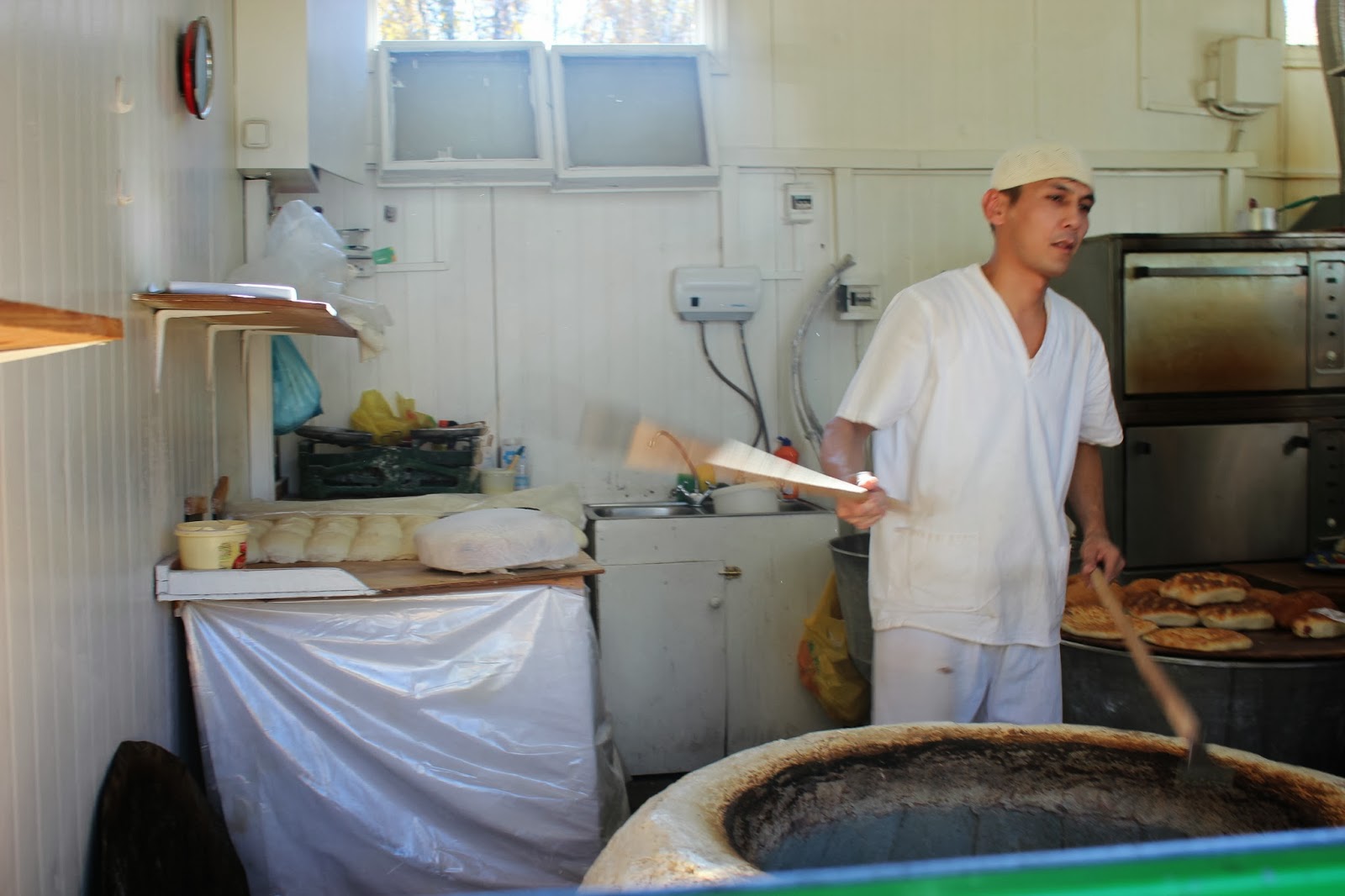
hungry from the adventure we found a great stall just beyond the metro where we feasted on chicken and ham filled bread for a scant $3.00.
Pulling our lunch out of the circular oven

- Kris


Thursday, August 29, 2013

Riding the "ъ" Bus

Several people suggested that I take a bus around the "Golden Ring Road" of Moscow to become acquainted with how the bus system works and how the city is laid out.  This turned out to be a great suggestion, possibly because of the amount of time I have looked at the map reviewing where I went.
Rather than being laid out in a grid fashion, Moscow has the old city centre, consisting of Red Square and the Kremlin, with a road running in a circle around it.  Called the "Boulevard Ring" it has two lanes running each direction and gardens in the medians.  The next ring out is called the "Garden Ring" which has four lanes of traffic each direction and no boulevards.  It was originally built in 1591 as a line of defense around the city.  1683-1718 the road indicated a customs border for those entering into the city to pay their taxes.  Markets began springing up around the outside of the ring as a way to evade taxes with the last of these markets being closed in the 1970's.  There are two more ring roads around Moscow, but  this is the road we were going to follow.
The Garden Ring is also referred to as the "ъ" ring, thus the name of the city bus we were looking for.  Moscow has a wonderful public transportation system in place.  The Metros or subways are timely and can get you almost anywhere.  The same ticket works on both the Metro and the busses.  Another great thing about the transportation tickets is that they are interchangeable and can be used for more than one person.  I bought a 20 ride ticket at the Metro station and just swipe it for each kid as they go through the turnstile to get into the Metro.  I used this same ticket for my bus ride.
I suggested this outing to a new friend so we left the embassy, walked a block to the main road and got on a bus for our 16 km ride right outside the American consulate.  Soon we arrived at Gorky park where we wanted to get out and explore a bit.  Walking on an overcast, cool day took us past gardens of flowers past their prime, summer amusement rides weary from the long hours and the almost empty wooden deck along the river that thrives with sun bathers on long summer days.  We stopped to watch three tap dancers as they practiced on the hollow sounding deck.  
Back on the bus a few stops later three gypsy women got on.  I actually don't know if they were official gypsies or from anther Baltic region, but to me they fit every description I have read of a traditional gypsy.  The boarded the bus and as one woman created commotion with the driver, the other two women effortlessly slipped under the turn-style.  They had clearly become experts in riding for free.  The last woman swiped her card and the bus took off.  They were dressed in long black velvet peasant style skirts with ribbon between each layer of gathered fabric.  Jet black hair was piled on their heads covered in silken scarves tied in a mysterious, intricate fashion.  I found them striking and mesmerizing not because of their beauty but because of an unseen force that they carried with them.
We reached a bit of a snafu when half way through our trip the bus stopped and dumped us all off.  As confused as the rest of the passengers we followed to another bus preparing to leave.  After a few minutes the new, bewildered looking driver let us on.  Several people tried to say something but he was making them all pay.  Not wanting to cause any ripples it seemed worth it to me to re-pay the $1.00 fare.  Another woman was not to be cheated and talked the driver into letting her through another door.  
We stood the entire ride so we could better see out the windows.  Large Stalin architecture covers the city.  Several buildings stood out but I am not oriented enough yet to know what they are.  We soon found ourselves back where we had started, in front of the American consulate.