Friday, September 23, 2011

Volcan de Lodo el Totumo

About half way between Barranquilla and Cartagena, sticking 49 feet from the flat landscape, is a mud mound that looks like a small volcano. Indeed it is a volcano, but rather than spewing lava it is filled with mud.

An ancient legend claims the volcano used to spew fire. The local priest believed it to be the work of the devil so he would sprinkle it with holy water. He extinguished the flames and turned the lava into mud which drowned the devil.

There are around 700 mud volcanos in the world. Most of these are in highly remote locations that are not accessible. Many are small and some are steaming hot. These volcanos emit gasses such as methane and helium. So, to find one that I can play in is a real treat.


We arrived mid-day when it was nice and quiet. We paid our $5,000 pesos (about $3.00 US), changed into our swimsuits and began the trek up the mud covered wooden staircase to the top. I didn't know what to expect. I came to the lip of the crater and looked down into a round pool that can hold 10-15 people smooth with mud. A staircase led into the pool. I turned around and began slowly descending into the mud. I didn't know when or if I would touch bottom. Now that I think about it, it is a volcano so according to definition there would be no bottom.

A man came over to assist my decent. The mud was thick and slightly warm. It had a bit of grit to it and a chunk every once in a while, but the mud is said to have healing properties. The man came over and began to massage me – included in the $3.00 fee. At this point I had lost all inabitions and just floated there enjoying the sun and the slimy feel of mud. The mud makes you very buoyant. It took concentration to keep from floating on the surface. Chad decided to go under. It's not possible by yourself, it took the masseuse all his weight to get Chad under.

After laughing and enjoying our soak we got out and started down the ladder. About half way down Chad wondered what it would be like to jump in. We went as quickly as possible with our slippery, muddy feet back up the wooden ladder. Chad pencil jumped then I followed with a cannon ball. Now we felt we had enjoyed the experience to the fullest.

We walked down the dirt road to the lagoon looking like complete zombies. At the lagoon we were met by some women ready to rinse us off. (Again included in our $3.00 fee.) It took quiet a bit of scrubbing before I began to feel the mud wash away but I was presented with a problem. A swimsuit full of mud giving me that “full diaper” feeling. I didn't care anymore – off with the suit. I felt like a maiden in Egypt bathing in the Nile River: warm water being poured on my head, reeds surrounding us, a boat in the distance... I ducked in the water, put my suit back on and headed to the changing room to get dressed.

We bought some cokes before we got back in the car to head to Barranquilla. It was probably one of the silliest, fun things I have ever done.

- Kris

Friday, September 2, 2011

Roses


If you purchased a bouquet of flowers from Trader Joe's, Whole Foods or Costco recently, most likely they were bred, grown and packaged in Colombia.
The United States imports 79% of its flowers. 65% of those flowers are from Colombia. Colombia is the 2nd largest exporter of flowers behind the Netherlands. 20,000 acres of land are committed to growing flowers. 79% of that area is in the Bogota Savannah and the remaining area is near the city of Medellin. These two cities are prime candidates for flower growing because of their high, sunny plateau regions. Colombia's nearness to the equator provides consistent long days of sunlight which makes the heads grow brighter and bigger and the high altitude grows better quality roses. Fertile soil, mild temperatures, cheap labor and close proximity to America have caused the Colombian flower industry to flourish.
This week I had the opportunity to visit “Rosen Tantau”, a German rose breeding company. Rosen Tantau in Germany is one of the most important rose farms in the world bringing many new varieties to the rose market each year.
How does a new variety of rose make it from imagination to your dining room table? Rose experts in Uetersen, Germany at the Rosen Tantau farm cultivate, select and test new novel varieties of roses throughout the year. New varieties are then sent to their greenhouses in Colombia for further cultivation and testing before hitting the market. The stem that arrives in Colombia is called a “code”. The rose does not have a name yet, only a number identifying it. The 3” code stem with a leaf is grafted into a rose root system to create a hybrid. The two plants will grow together to create a new variety. Rows of each variety grow in the greenhouses.
Rose Grafts
If a rose achieves the desired qualities for a market it will be given a name by the owner of the greenhouse, receive a patent and go on the market. The Russian market desires solid, large heads that are open whereas the American market desires small, closed heads. Different colors are also in demand in different markets of the world. Once you have a hybrid rose you can not use that breed to graft another plant into. The new plant would be too weak and have problems because the gene pool has been altered.
Other farms will now come to Rosen Tantau to place orders for flowers they would like to grow. A farm may request 100,000 plants of one variety and 1,000,000 of another. Rosen Tantau has greenhouses where they grow commercial plants as well for sale on the market.
Roses, carnations, chrysanthemums and alstromeria are the main types of flowers grown here in Colombia.
When the stems have reached the desired “cutting stage”, the stem is cut and the flowers go into the warehouse to be packaged. The cutting stage is how the flower head opens. The U.S. Market desires a closed head whereas the Russian market desires a partially open head. Length of the cut stem is important in the quality as well.
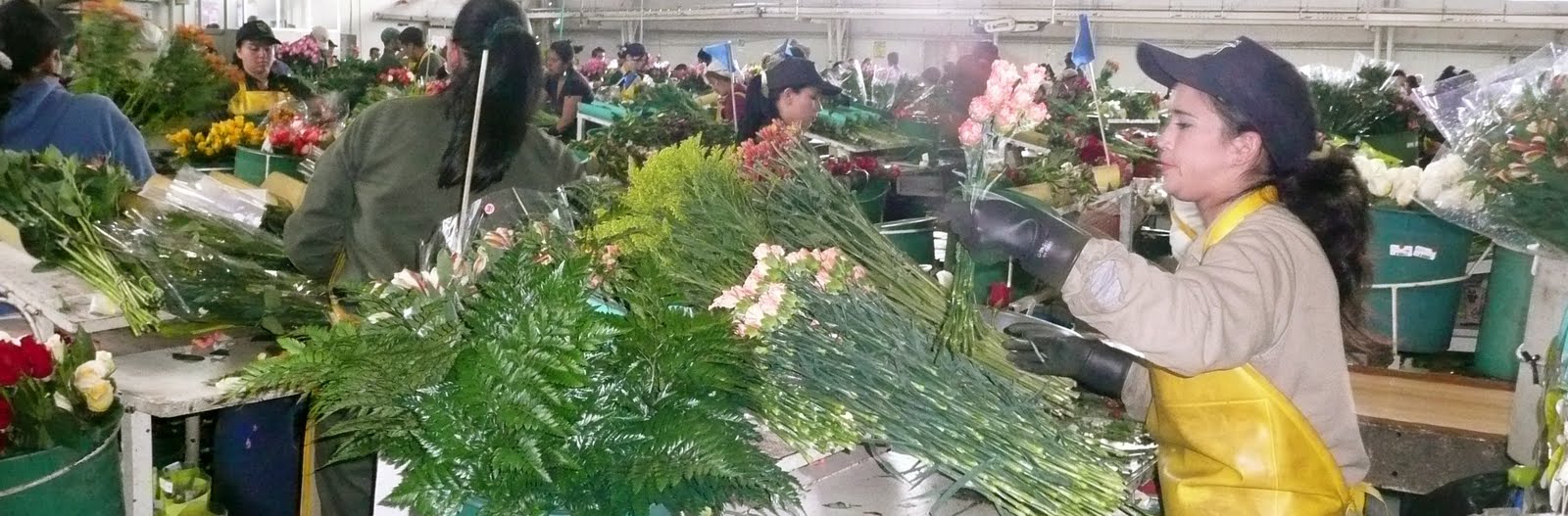
There are rows of workers in the warehouse preparing bouquets to be shipped out. Each station has a paper with the “ingredients” for the bouquet listed. Piles of each type of flower are in front of her. She takes the required amount of stems for one bouquet, puts them together, uses a machine to cut the stems, then places the loose bouquet on a conveyor belt where another person will pick it up, rubber-band it, put in a packet of flower preserver and the final plastic or paper wrapping around it. She then places the bouquet in a bucket of water. Each bouquet maker has a flag at her station. As she begins to get low on flowers she replaces the flag with a colored flag to indicate more flowers are needed for the order she is working on. A runner places more flowers in the bucket next to her and as she needs them she can move them to her work area.
The completed orders of bouquets are placed in refrigerated trucks and transported to the Bogota airport where they will fly out during the night. The majority of the flowers head to Miami where they are inspected upon arrival. 10% of each shipment is taken out and destroyed by beatings and thrashings to be sure no unwanted pests or disease are let into the country. The inspectors are also checking to be sure no drugs are being smuggled with the flowers.
90% of Colombia's flower export is to America. Within 48 hours of a flower growing in a field here in Colombia it is in a warehouse in the United States. Give it another 48 hours and it is at your local retailer's and possibly in your home. Once you have received the flowers into your home there are a few things you can do to help prolong their life and keep them looking as gorgeous as possible. Cut the stems on a long 2” angle. This will help keep the flower stem from being blocked by bacteria. Remove all leaves that will be in the water. Place the stems in fresh, warm water. A drop or two of bleach will prolong the flowers and a teaspoon of sugar will help the heads to open sooner. Keep the water fresh so the flowers don't get choked by sludge.
The flower houses around Bogota provide work for more than 100,000 people. The majority of them are women. The flower houses encounter the same problems that any other factory job encounters. The women are on their feet the entire work day. There is some machinery present where accidents could happen and where do the children go when their mothers are working? Rosen Tantau farms have strict quality control rules to keep the working environment safe. The floors are continually swept clean of petals and stem pieces. The plants scraps are swept into a channel of water in the center of the floor when they flow out of the buildings and into a filter system. The plant waste is then composted for future use on the farms. Rosen Tantau in Colombia has also set up 2 foundations to encourage the continuing education of its employees. The first foundation allows the workers to receive more education. The second foundation provided education for the children of the employees. A very small fee is charged for each child to receive day care and schooling while their parent is at work all day. If you purchase flowers at Whole Foods, you will be happy to know that a % of your cost is going to this foundation to educate the children.

- Kris


Thursday, September 1, 2011

It's been awhile since I wrote

We are settling in.  Not the easiest thing, as this country has the fewest english-speakers of any I've visited.  My clunky Spanish gets me around just fine, but Kris  and the kids have adventures daily (Kris might use a different word).

Bogota is a great city.  It is distinctly third-world, with horse-drawn carts everywhere on the streets and great swaths of nun-down tiny shops and shacks.  I feel drawn inexorably to the vendors on the streets who sell chiclets and cigarettes out of wooden boxes hung from their necks.  I have no love of either item, but finally broke down and bought a packet of certs mints from a lady today (she asked $1, but I successfully arranged a 30% discount--lucky me).  Anyway, I've also purchased coffee on the street from one of the thousands of vendors of everyday necessities (ie, coffee, fruit, cigarettes and chiclets) located conveniently on and between every street corner in the city.

The nearest park has a giant screen tv on which soccer games are shown every weekend.  The crowds for this are huge and energetic, though not at all intimidating.  About 9am on Saturday and Sunday a parade of black-shirted men open locked tents in the park and begin a bag-brigade, throwing large bean bags from hand to hand and lining them up in front of the mega-tv.  We've seen fans show up to claim a bag 4 hours prior to the beginning of a game!

I've been away in Ecuador for the past week, checking things out at two of the posts there.  It's a beautiful country, but I've seen woefully little of its mountains and coastline on account of a busy schedule.  I'll return in a couple of months to spend some time.  That trip will be extended by at least a day to see either a rain forest park I heard about or a shrimp farm owned by a guy I met the other day.  Emilio is an Ecuadoran-Italian and aquaculturist with a serious surfing habit.  Needless to say an interesting guy.

Ok, my plane back home boards in a few minutes and I've written about three more paragraphs than I meant to.

- Chad

Saturday, August 27, 2011

Embassy Kids Day: The Dog Show

On Friday Mom, Damon, Maddie, and I woke up early and took a taxi over to the U.S. Embassy where Dad works. Dad would have come with us to work that day, but he decided to stay home because he wasn't feeling very well. It was “Kid's Day” at the Embassy and Mom signed me up so that I could meet some new people and she thought it would be fun, for a change, compared to sitting around the house all day! Mom, Maddie, and Damon came because Maddie and Damon are now in High School so they were old enough to be helpers. The Kid's Day would take almost all day, so we started right away when all the kids were gathered in the room with an orientation of what we would do today. I was sitting next to a little girl a couple years younger than me that was the daughter of one of the Nurses in my Dad's office, we had offered her to walk down with us. She didn't speak much English, mostly Spanish, so it was a little hard to communicate with her sometimes. But I was very grateful that she spoke the slightest bit of English because she speaks way better English than I speak Spanish! The first thing we did after the orientation was split into groups, Kindergarden-3rd Grade and 4th Grade-8th Grade, that was the group I joined along with Damon being a helper. Mom and Maddie were assigned being helpers for the younger group. The first activity my group went to was the News Room. It was a lot of fun seeing what it was like to try and control the sound and be interviewed while being videod. It was a lot of fun. Right when we first started going around to the different stations a girl introduced herself as Gabi to me. We became quite good friends as the day went on, as I knew no one else there. Gabi had been in Colombia with the Embassy for 3 years and was staying another 3 years, so obviously she speaks quite good Spanish! As the day went on and we went to more and more stations. We finally went to the one that I found I like the best. Both groups joined together for the first time since this morning and we all sat in a line. Snacks were handed out as it was almost lunch time and we were all very hungry! We sat in the court yard talking for a couple minutes when finally about 7 men each with a dog, started walking around. Every once in a while they stopped, the dogs automatically stopping along side the men. All the Dogs were German Shepherds, except 2. One of the 2 was a Golden Retriever and the other, upon my friend asking in Spanish in the end, was a mixed German Shepherd and Golden Retriever. We all quieted down and the fun began! The men brought out 3 little table things, and a dog layed on top of each of them. One of the dogs jumped over the tables with the dogs on top of them, all the the tables in a row. Everyone clapped and a couple more dogs went, when it was the Golden Retriever's turn he started running towards them but just when we thought he was about to jump, he arched his back downwards and crawled underneath each one of them, everyone laughed and clapped. We all could tell by the level off energy and the looks of the dog that it was a bit older then the others and near the retiring age. The men leashed up the dogs once again marched around one last time and then for the grand finale they brought out 3 hoops connected to a stick making them stand about 3 feet off the ground. Next some of the guys brought out some matches and lit them on fire, we all widened our eyes in anticipation of what we knew was coming! The owner of a German Shepard unleashed his dog and said a command pointing towards the 3 lined up hoops. The dog took off at a run and jumped perfectly through all three flaming rings one after another! A couple more dogs took their turns and the occasional dog would shy away from one of the rings, the master then making the dog stop and backtrack to take on the hoop again, then normally clearing it after that try. The men cleared the courtyard again and then took and bow. We all cheered and then got herded towards the next event of the day!

By: Elena

Friday, August 19, 2011

Secret Service

Maddie and I were too old to go to the elementary and middle schooler's party, so mom made us be chaperones. The rest you can guess, the only thing we really did was tell the kids to be quite, and that in-its-self was a lost cause. Though, not all of it was little kids jabbering to their friends as we waltzed through the United States Embassy, even I did learn a few new things.

Each of the major sectors of the embassy put on a demonstration/slide show to inform the children on what happens in this embassy. One in particular, the Secret Service. What does the Secret Service do? Just protect the President right? Actually there is a bit more than meets the eye. Yes, the Secret Service is responsible for “the protection of national and visiting foreign leaders”, but “the Secret Service was established in 1865, solely to suppress the counterfeiting of U.S. Currency”. Today the Secret Service has two goals, to exploit counterfeiting and to protect “national and visiting foreign leaders”. They thought it was a good idea since a number of the Presidents that were getting assassinated/killed was far too high.

The protection the Secret Service has to offer is a rare one, protection to the President and his family for life, Although President George W. Bush and later presidents do not receive protection for life because the previous President changed the law. People in the Secret Service receive vigorous training in which they learn in extreme depth everything there is to know on protection.

The other “half” of the Secret Service is investigations on counterfeiting. The man who was giving the demonstration is in the Secret Service and displayed uncut counterfeit money for us to examine. He gave us a few ways to tell if money is counterfeit.

The paper: the paper used to make real money is too expensive for the counterfeiters to use, so when you feel the counterfeit it does not feel the same as real money. The bill: it has a letter and the number according to the mint it was manufactured from. The same letter always goes with the same number, A1, B2, C3... etc. Watermark: if you hold a real bill up to a light another image in the paper becomes visible that you otherwise could not see. If the water mark is visible without holding it up to the light or if it is not visible when held up to the light then it is a counterfeit. Although there may be other ways of determining whether or not a bill is counterfeit these are a few of the simplest ways.

Since the Secret Service has started protecting the Presidents, although there has been attempts, only one has been successfully assassinated. R.I.P. JFK.


~Damon A. Faber~


Works Cited

http://www.secretservice.gov/whoweare.shtml

Tuesday, August 16, 2011

Embassy Kid's Day – Night Vision Goggles


The kid's day at the Embassy was on a Friday. Elena went to it, and Damon, Mom, and I helped with it. Mom and I were with the 3rd through 5th graders, and Damon had 6th through 8th. All the kids were really excited to see the night vision goggles, but it was later in the afternoon. Finally our group got to go into the room and there was a big, long table that the kids sat down at. The table had lots of stuff on it, like a few plastic guns, night vision goggles, and helmets and hats. A speaker talked, but someone translated because it was in Spanish. He talked about what the Gorillas did, and how they went into the jungle to find drug maker's buildings, and then they would blow them up. He explained that in the jungle you had to be careful, in case there were land mines around.

He showed us a mine detector that beeped when it got close to a mine (or batteries, as he showed us with); it looked pretty much like a metal detector. When he finished talking, they turned out the lights and we got to look through the night vision goggles. They did it a second time for everyone who didn't get a chance. You could see quite a bit through them, but it was all tinted slightly green. When you had a bit more light, you could see even better. Right at the end, kids lined up to get a picture with the mine detector, then we had to leave to switch with the other group.

By Maddie

Friday, August 5, 2011

El Chico

On Tuesday my Mom dragged me and my sistersto a museum. It was only a 5-10 minute walk from our new apartment and upon arriving Maddie realized she had lost her coat. Maddie and I headed back to see if we could find where she might have lost it. We went a third of the way back and decided it was gone. The museum had a big park with swings and pyramid merry go rounds and lots ofgardens andfountains.We decided to check out the park section of the museum after the part inside, but unfortunately the museum was closed during the one hour we were there. Mom and Maddie decided they would further investigate Maddie's missing coat and backtracked all the way to the apartment. Elena and I stayed to explore the park, only a minute later a man,with a few little boys trailing behind, came up to me and asked if I would like to play soccer. I said yes, and even though it took a while, I convincedElena to play as well. He told us how he came there often to play with the little kids. As it turned out he worked at the U.S. Embassy, what a coincidence! We played for awhile until Maddie and Mom finally returned empty handed. The museum had now opened and we went to that next. The museum as it turned out was just an old house which had been owned by a Spanish conquistador then when the last owner had no kids, donated it and its grounds to the city. A guide led us through the house which was filled with ornate furniture from around the world. Many parts of the housewere closed either permanently or for touch-ups.The museum which mom had planned to take the whole day ended in ten minutes. We went to check out the grounds and messed around on the merry-go-round and theteeter-toters before headingback to the apartment.Mom will undoubtedly return when more of the house/museum is opened.